

Welcoming Shabbat
Serving Challah
Welcoming Shabbat
The Dinner Table as the Altar
A little history lesson…
Our tradition teaches that the position of the Altar in both the first and second Temples was precisely on the site where the Binding of Isaac took place.
Central to our religious rites were the sacrifices performed at this altar by the priests, all of whom were descendants of Aharon, brother of Moses and our first High Priest.
In 70 C.E., the conquering Romans brought down the second Temple, and our people began scattering across the world. Our sages knew that if we were to survive as a cohesive people, we would need something to bind us to one another as securely as Isaac was bound to that rock. Synagogues and Yeshivas could fill in for the Temple as places of worship and learning, and the Siddur, the prayer book with its formalized prayers in Hebrew, could ensure that any Jew could walk into any synagogue in the world and be able to follow the service. But the location of the Altar is immutable. The altar was in the Temple, and sacrifices can be performed there and only there.
A new age was dawning. The old ways of sacrifice-centered worship were passing into antiquity in most of the world's religions. Our priests were replaced by Rabbis—teachers ordained by merit rather than birthright. But how could we maintain the transformational, spiritual energy—the blessings, the atonement for sins—that had once come to us through the Temple rites at the Altar? It would have to be something so powerful that, no matter how far the physical cords between us stretched, they would never break.
That conduit is the Shabbat dinner table.
As long as the Jews keep Shabbat, Shabbat will keep the Jews.
What We Envision, We Create
Kabbalah teaches that the seven days of the week correspond to seven attributes of God, represented by the lower seven vessels on The Tree of Life.
As the seventh day, Shabbat is referred to as a Queen and as the Bride of Israel.
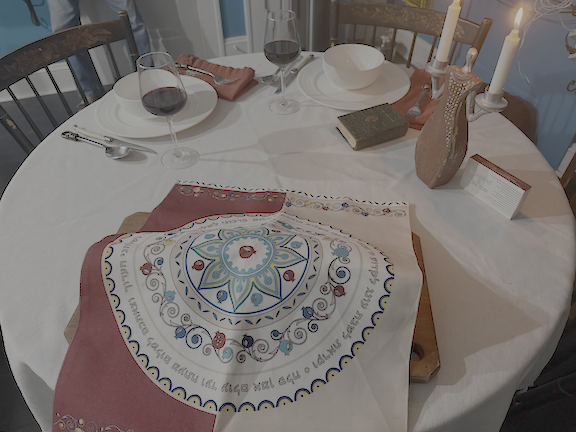
Set the Table
As you set the table for Shabbat dinner, try to hold in your mind the thought that you’re creating a Holy Altar. Make it beautiful in a way that speaks to you. That could be the traditional white tablecloth, fine china, and crystal glassware, but it doesn’t have to be. Anything that feels festive, elegant, or special to you is perfect. Your focus and intention are the magical tools that will make this space, in this time, sacred.
It’s a good idea to have everything you’re going to need at the ready, so things roll smoothly.
Set out a Siddur (prayer book) for the person who will chant the Kiddush (the blessing of the Sabbath and the wine.)
If you don’t have a siddur, there are many sources online for the Friday night Kiddush.
Remember to have a corkscrew at the ready if needed. Each person at the table will need a glass for water (or whatever beverage you’re serving) and a cup or glass for wine or grape juice. Flowers on the table are always a nice touch.
In the Temple, there was a special table to hold the Lechem Panim, the twelve loaves of Showbread (literally, the bread of faces). These loaves, set out as an offering, were baked fresh and replaced weekly. On the Altar that we’re constructing, two loaves of challah are set on a board. A decorative challah cover should cover the bread if you have one; if not, a simple napkin will do just fine.
Why do we cover the challah? Challah represents Shabbat, the bride of the people Israel, and so like a bride, challah comes to the altar, veiled. When the cover is removed and the blessing is said, we have unified bride and groom, king and queen. Then, we celebrate with the wedding feast.
Why two loaves? During the Exodus from Egypt, a miraculous food, manna, appeared six mornings a week, covered with dew to protect it. The challah represents the manna and its cover represents the dew. Manna didn’t fall on Shabbat, when we’re instructed to refrain from work. Instead, a double portion appeared on Fridays; hence, two loaves of challah. (The seeds that may have been sprinkled on the bread before baking also symbolize the manna that fell from the heavenly realms.)
A small dish or shaker of salt is set down next to the challah board. Any salt will do, but I like to use a specialty salt, to enhance the mood of this being a special time. There are so many fun varieties readily available now.
Why salt? There’s a Midrash (story from the Oral Torah) that tells this story:
The world is one part wilderness, one part settled land, and one part sea. Said the sea to The Creator, "Master of the Universe! The Torah will be given in the wilderness; the Holy Temple will be built on settled land; and what about me?" The Holy One replied "The people of Israel will offer your salt upon the Altar."
Salt was always present on the Altar, to be used in the Temple sacrifice to God. Salt is a necessity for life—without it, our muscles wouldn’t function and our hearts couldn’t beat—and so, salt is required for the "food of The Creator." Salt is the preservative that never spoils. In the Torah, we’re told to offer salt with all sacrifices, so salt should be placed on the table before the blessing over the bread is chanted.
While challah is the focal point of the Shabbat table, serving challah is not an independent event. Rather, it’s just one of the rituals of the Shabbat dinner table. Together, they’re all part of one experience, each inextricable from the next.
For those who observe Shabbat, Friday afternoons can feel hectic. Everyone is rushing around, making preparations. Then . . .
Eighteen minutes before the sun sets on Friday evening, we light the candles and chant the blessing, welcoming Shabbat. Once we’ve done this, anything that hasn’t yet been done will remain undone. The workweek has ended.
Shabbat slips into the home like liquid mercury, sliding in under the doors, seeping through the walls. She is here! Some have a custom of opening the door to greet her, and some run outside to meet her on her way, to escort her in like a queen before lighting the candles. Some light the candles and head to a west-facing window or step outside—enjoying a few minutes of contemplation as they watch the setting sun. Find what works for you, what helps you to enter a state of sacred time.
Traditionally, the mitzvah of lighting Shabbat candles is performed by women. In some families, the “lady of the house” lights and chants the blessing. Either she chants alone or is joined by the other women present. In some gatherings, the woman whose home it is lights two candles while all the other women present also light a candle. One woman can light the candles for everyone, or each woman can light one. If no women are present, it falls to a man, or the men, to light the candles.
Traditions are wonderful, but remember that every tradition starts somewhere, so don’t hesitate to create your own way of doing things within the halacha of Shabbat. In our family, it’s usually me who lights the candles, and we all—with no regard for gender—chant the blessing together. What feels right to you may someday be a time-honored tradition for others!
Light the candles. Open your arms wide, encircle the light, and bring it towards you three times. Then, cover your eyes and chant the blessing.
The Blessing:
One might expect some lofty message in the blessing we make over Shabbat candles.
But, after all the fanfare, all we’re saying is that, You told us to light candles, so we’re lighting candles. Kind of dull and uninspiring. What’s the point? Why do we need to tell God what we’re doing and why we’re doing it? Doesn’t God Know?
The blessing is for our benefit, to encourage our focus, to remind ourselves that we’ve chosen to observe the mitzvot, to bring to our awareness the sanctity of the moment. This awareness allows space for the light to enter us, allows room for us to receive an extra soul, a higher soul more capable of receiving Great Truth—our Shabbat soul—into our being.
The candles are an outward expression.
What we’re doing is kindling the light within ourselves.
Baruch Atah Adonai, Eloheinu Melech Ha’Olam, asher kiddishanu b’mitzvah-tov vitzei vanu l’hadlich ner shal shabbat.
We praise you, are grateful to you, and implore you to meet us in a place where we can relate to you, Adonai our God, Sovereign of Space and Time, who bids us to kindle the Shabbat lights.
Everyone replies, “Amen!”
When we come to the table, the first thing we do is “make kiddush,” chanting the blessing over the wine or grape juice. Someone, or everyone together, chants the kiddush. Everyone who can, (usually) stands and holds up their cup as the kiddush is chanted.
The short version goes like this:
Baruch atah A-donai, Elo-heinu Melech Ha' Olam, Borei P’ri HaGafen
Baruch ata Adonai our God, Sovereign of Space and Time, Who creates the fruit of the vine.
In many families, the entire kiddush is chanted. This is where having the siddur on the table is helpful. For the full text of the Friday night Kiddush, I offer it here.
-
Baruch atah, Adonai Eloheinu, Melech haolam, borei p’ri hagafen. (Everyone responds with "Amen")
Baruch atah, Adonai Eloheinu, Melech haolam, asher kid’shanu b’mitzvotav v’ratzah vanu, v’Shabbat kodsho b’ahavah uv’ratzon hinchilanu, zikaron l’maaseih v’reishit. Ki hu yom t’chilah l’mikra-ei kodesh, zecher litziat Mitzrayim. Ki vanu vacharta, v’otanu kidashta, mikol haamim. V’Shabbat kodsh’cha b’ahavah uv’ratzon hinchaltanu. Baruch atah, Adonai, m’kadeish haShabbat. (Everyone responds with "Amen")
-
Baruch ata Adonai our God, Sovereign of all, Creator of the fruit of the vine. (Everyone responds with Amen)
Baruch ata Adonai our God, Adonai our God, Sovereign of all, who finding favor with us, sanctified us with mitzvot. In love and favor, You made the holy Shabbat our heritage as a reminder of the work of Creation. As first among our sacred days, it recalls the Exodus from Egypt. You chose us and set us apart from the peoples. In love and favor You have given us Your holy Shabbat as an inheritance. Blessed are You, Adonai, who sanctifies Shabbat. (Everyone responds with Amen)
Washing Hands:
Next, we prepare to bless the challah. Although we’ve probably washed our hands before we sat down, we ceremonially wash again.
The person who’s going to chant the blessing over the bread, or everyone, whatever works for you, performs this ritual cleansing. Using a special cup, we fill it with water and pour a little over each hand, first over the dominant hand, and then over the other hand, twice or three times according to personal tradition.
During this ritual, we try to concentrate on self-purification, of washing away the strains of the week as well as any less-than-admirable choices we might have made. After the pouring of the water, hands are raised chest high while chanting the blessing,
Baruch atah A-donai, Elo-heinu Melech Ha'Olam, asher kideshanu b’mitzvotav vetzivanu al netilat yadayim.
Baruch ata Adonai our God, Sovereign of Space and Time,
Who has sanctified us with Your commandments,
and commanded us concerning the washing of hands.
And now, it’s quiet time!
After handwashing and before “making haMotzi,” the blessing over the bread, it’s traditional to remain silent.
Blessing the Challah and by extension, all of the food we’re going to eat, raises its spiritual value. The idea is to let the food enter our bodies and raise us up as well.
The person who’s making HaMotzi removes the cover from the loaves and raises them up, one loaf in each hand. They’re held together while chanting the blessing—
Baruch atah A-donai, Elo-heinu Melech Ha'Olam, HaMotzi Lechem Min HaAretz
Baruch ata Adonai our God, Sovereign of Space and Time, Who brings forth bread from the earth.
—and the tears off, or cuts off, a small piece of challah, dips it in salt, and eats it. Now you may speak, as pieces are distributed to everyone at the table, to dip and to eat. Then, dinner is served.

And that’s where this website, The Twisted Challah, steps in.
On this site you’ll find a menu designed to reflect each weekly parasha, along with my own musings and meanderings on the reading. And, you’ll find the recipes for each item on the menu.
Click here for a list of the weekly readings, or check the home page for the current week’s parasha and menu.